A career in real estate can be very lucrative once you become established, but it often takes time to build a steady income. Unlike many other fields, you don’t earn a salary in real estate. Your income is driven by commissions that come from the deals you close. For most new real estate agents, the first year is spent building a business and finding clients to work with. Often, you may not close your first deal for several months, if not longer, and you may only close a small number of deals throughout your entire first year.
While your long-term income can be very strong, it’s important to prepare for a first year that delivers uneven income or, in some instances, no commission income at all. This requires saving money in advance to cover your personal expenses and business costs. With the proper savings plan and initial budget, you can make sure you’re financially prepared to get through the first year until you begin getting enough clients to build a significant real estate income.
Building a budget is always a good strategy to effectively manage your finances, but it’s especially important when your short-term income is uncertain and likely to be small. When planning your budget, make sure you separate it into the following categories:
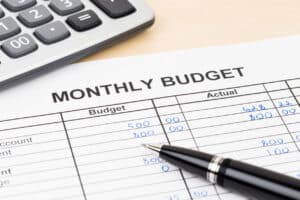
Write down a list of all your monthly living expenses and the approximate cost of each item. This should include:
These expenses should be your top priority every month. In addition, try to limit the additional monthly personal expenses you take on beyond these essential items. If you can live on a more stripped down personal budget during the early stages of your real estate career, it can help you stretch limited earnings a little further.
When budgeting for your business expenses, you should allocate money for both your start-up expenses and your monthly business costs. Your start-up expenses refer to the costs associated with getting your real estate license. These include:
You’ll also want to create an estimated budget for the monthly and annual business expenses you’ll incur once you get your license and start your real estate business. These include:
Since real estate agents typically operate as self-employed independent contractors, your brokerage will most likely not withhold income taxes. You’ll need to work with an accountant to estimate the amount of money you’ll need to put aside for taxes. Otherwise, you may end up with a large expense at the end of the year that wasn’t budgeted for.
While your monthly personal and business expenses are fairly easy to itemize and plan for, there will always be some expenses that occur unexpectedly. It’s important to include money for an emergency fund in your budget so that you’ll be able to cover costs associated with a vehicle breakdown, health issues, home damage or any other sudden expense that must be addressed.
Creating an emergency fund will help you avoid putting these costs on a credit card, which can cause you to take on unnecessary debt. The specific amount you allocate towards your emergency fund should be dictated by your financial constraints. Don’t overextend this fund beyond what you can realistically afford to set aside.
Before you make the transition to a full-time real estate career, make sure you save up enough money to cover your initial expenses. You should aim to save at least enough money to cover your start-up costs as well as the first six months of your personal living expenses and monthly business expenses. If you’re able to save for your entire first year of expenses, that will give you more of a cushion and protect you against the possibility that it takes longer than expected to earn your first few commission checks.

Leveraging one of these expense tracking systems will allow you to review your budget monthly to ensure you’re staying on track with your spending. If you notice that you’re exceeding your budget, you can make adjustments as needed to curb your monthly spending.
Your real estate practice is a business entity and should be treated that way. This requires a dedicated business account. When you have a separate business account, it will be easier to track your income, monitor your business expenses and pay your taxes. It also prevents you from paying your monthly personal living expenses from your dedicated business funds.
It’s understandable if you’re unable to save enough money to cover your first year’s personal and business expenses. That doesn’t mean you have to delay starting your real estate career until you’ve built up additional savings. Many new real estate agents will get a part-time job or keep working part-time at their prior job until they become more established in their real estate career.
This may mean that at first, you’re splitting your time between two jobs and only working part-time in real estate. For many new real estate agents, this provides a more sustainable way to maintain financial security as you make a career transition.
Keep in mind that there are a few tradeoffs associated with this approach:
For these reasons, it’s best to consider this part-time arrangement as a temporary solution that allows you to build up your savings while you establish your new real estate business. If your goal is to eventually work full time as a real estate agent, you should build a full-time transition date into your initial business plan. This will provide you with a concrete goal to work towards and help you stay on track with your savings.

All our online real estate courses are developed and taught by local, licensed real estate professionals. In addition to covering the essential information on the real estate exam, our instructors provide you with insights into the latest trends impacting the Colorado real estate market. Our instructors know what it’s like to start out as a new real estate agent, and they also share valuable tips that will help you build a successful business.
Our courses give you access to our VideoConnect Success Learning System™ containing the largest library of video content available. These engaging video lessons create an authentic classroom environment that elevates your learning.
At Colorado Real Estate School, we back up all our courses with our TruSupport Pass Guarantee™, which provides you with additional support if you don’t pass your exam on the first try. You’ll get extended access to all course materials while you study to retake the exam. We’ll also pair you with an instructor who will analyze your test results to identify the concepts you found most challenging. Your dedicated instructor will work with you to develop a customized study plan emphasizing these concepts so that you have the greatest chances of achieving a successful outcome when you take the exam again.
Contact us today to learn more about our online real estate courses.
You should aim to save enough money to cover your licensing start-up costs, such as pre-licensure courses, exam fees, and license fees, along with at least six months of your personal living expenses and monthly business costs. Saving enough to cover a full year of expenses provides an even stronger cushion, since it can take several months or longer to close your first deal and start earning consistent commission income.
Building a first-year budget as a real estate agent involves separating your expenses into three categories: personal expenses, business expenses and an emergency fund. Personal expenses include costs such as rent or mortgage payments, health insurance, utilities and transportation. Business expenses include one-time start-up costs, such as licensing fees and errors and omissions insurance. It also encompasses ongoing costs, such as MLS fees, brokerage fees and marketing expenses. An emergency fund covers unexpected costs, such as a vehicle breakdown or a health issue.
New real estate agents need to budget for both start-up business expenses and ongoing monthly business expenses. Start-up expenses include pre-licensure courses, exam fees, license fees, errors and omissions insurance, and background check costs. Ongoing expenses include MLS fees, professional association membership fees, brokerage or desk fees, marketing costs, CRM costs, license renewals, continuing education, and travel expenses.
Yes. Real estate agents typically work as self-employed independent contractors, so your brokerage will most likely not withhold income taxes from your commissions. You’ll need to work with an accountant to estimate how much money to set aside for taxes throughout the year to avoid an unexpected tax bill.
Getting a part-time job or continuing to work part-time at a prior job is a common way for new real estate agents to maintain financial security while their business gets established. This approach comes with tradeoffs, including a higher risk of burnout from working two jobs, slower progress building your real estate business, and less flexibility to respond to clients or schedule showings. Many new agents treat this as a temporary solution and set a target date for transitioning to real estate full time.
A dedicated business account makes it easier to track your income, monitor your business expenses, and prepare for taxes as a real estate agent. It also prevents you from paying personal living expenses out of the funds you need for your business, which helps keep your business finances organized and accurate.
Choose the Online Real Estate Package That’s Right for You
View Package Pricing